




Technology in translations – the impact of AI

There’s a great deal of well-founded enthusiasm surrounding machine translation in both the language industry and its clients. In certain cases, machine translation can provide undeniable benefits in terms of efficiency, but it must be handled with understanding, great skill and familiarity with the process and the technology – in combination with post-editing and meticulous text review. This post takes a closer look at AI and machine translations, and what to bear in mind in your translation projects.
AI and translations
In recent years, advances in AI have led to the increasing use of machine translation. Thanks to neural networks and large language models, an AI translation can now be surprisingly good, especially in the case of simpler texts and common language pairs. Thus many companies and organisations seeking to streamline translation work and reach global audiences more quickly are making increasing use of AI translations.
However, because there are certain limitations and risks to take into account, especially in the case of nuances, tone and subject-specific terminology, the most reliable solution is to combine modern technology with human expertise in order to achieve the highest quality and ensure your confidence in the translation.
Common pitfalls
Although machine translation has improved significantly through AI and neural networks, the technology still carries risks. One of the main challenges concerns AI hallucinations; these are things that are added to or disappear from a translation compared with the original text. Because the text is overwhelmingly correct in terms of grammar, syntax and spelling, hallucinations can be very difficult to spot.
Common risks associated with AI-based translation
- terms are added, used incorrectly or disappear entirely
- words like ”not” are added or omitted
- words in the singular are translated as plural or vice versa
- incorrect numerical data, e.g. decimal separators changed to thousand separators
- minus signs disappears
- currencies and/or units are confused.
Such mistakes can have serious consequences and in the worst case harm your company's reputation. Because even the most advanced machine translation can suffer from hallucinations, human quality control is the key to safe, accurate translation.

How does Språkbolaget regard AI?
Naturally, Språkbolaget has closely followed the development of AI. In the projects we work with, human expertise is fundamental for ensuring style and content are correct. This applies equally to lively social media copy and annual reports or medical texts. But in some cases, machine translation reviewed by human translators can be a viable option, for example when large volumes of text must be translated quickly to provide an understanding of the content, especially if the text is for internal use in the company. To help us analyse suitability, we use the following risk assessment matrix.
Risk matrix for translations
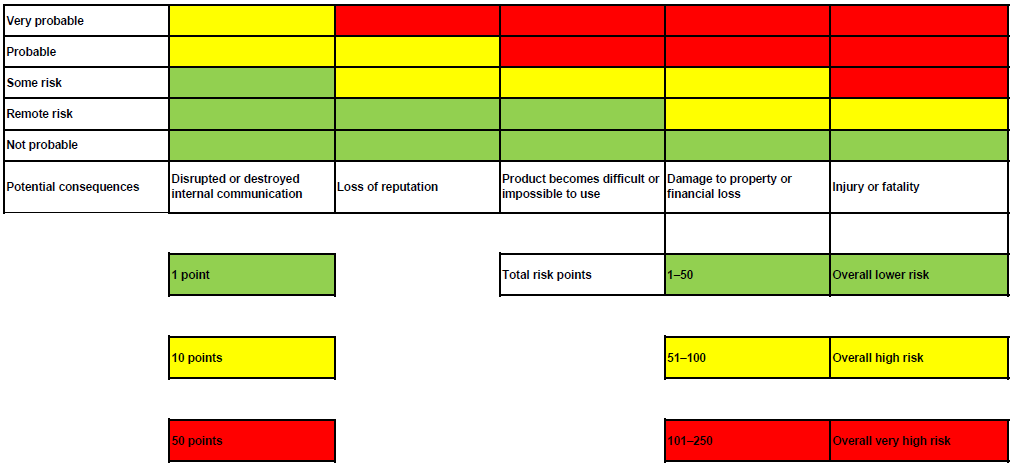
Horizontal axis – potential consequences of a poor translation
The horizontal axis shows the potential consequences of a translation that fails to reach the right quality level. This might concern
- disruptions in internal communication inside a company – can be resolved with a quick phone call
- damaged reputation among the target audience – may take time to repair
- difficulties for the end-user when using a product – can lower product ratings and reduce sales sharply
- financial loss – could be due to poor wording in an agreement; the loss can be unlimited
- fatality – simply cannot be allowed to happen.
Vertical axis – probability of something occurring
The vertical axis shows the likelihood of something on the horizontal axis occurring in the event of a translation flaw – the scale ranges from very low to very high probability.
While a translation project that ends up in the green lower left part of the matrix may well be important, it’s perhaps no more critical than a weekly management newsletter to employees in another language area. In such a case, dubious wording might raise an eyebrow or two around the coffee machine and maybe lead to some explanatory chitchat, but it will stop at that.
If the project is somewhere in the yellow area, it could concern a quarterly report, where an unclear description of the company's future plans causes investors to draw in their horns, or an instruction manual where an incorrect term makes it impossible for the user to understand how to operate the product.
A project in the red area might be a contract where a missing ”not” or an incorrect currency designator would entail enormous costs for one of the parties, or it could be safety instructions for a heavy machine tool that runs amok, risking the life of the operator who has diligently read what in fact was an incorrect instruction.
Green projects – low risk
Green projects are those where machine translation, post-edited to achieve human quality, can be entirely sufficient – linguistically correct with functionally sound content, but where there’s no need for a literary masterpiece.
Yellow and red projects – high to very high risk
While machine translation could play a part early on in the yellow and red projects, the overwhelmingly predominant part of the work here concerns editing, re-editing, letting the text rest and editing again. One or two more pairs of eyes review the text with scrupulous care, double-checking all terms, and carefully weighing every turn of phrase.
Let us help you make the right choice
AI and machine translation can offer significant advantages in terms of time and cost. At the same time, it’s important to remember that nothing beats the linguistic finesse and contextual understanding of an experienced translator. Språkbolaget works mainly with critical texts in the yellow and red zones, such as contracts, annual reports, user manuals for medical technology, high-end marketing and similar. But every project has its own character and not everyone needs the human touch to the same degree.
If you’re thinking of using AI in your translation projects, we recommend you consult Språkbolaget first. We can help you
- assess the complexity and risks associated with the text
- choose the right process for your text type and industry
- minimise the risk of errors, thereby protecting your company's reputation
This will help you avoid unnecessary mistakes and make sure your translation puts across what you want to say in the right way, and in the right language.