




Translating marketing texts – by translators with a flair for copywriting
Accurate information, attractively packaged
Marketing texts, also known as advertising and copywriting, must not only put across information, but also provide an experience and convey a feeling. The reader should receive relevant and correct information about the product or service described, and also be convinced that the product concerned is the right one for their business. A successful, appealing translation captures the essence of the source text, conveys its message and evokes positive feelings in the local market’s target audience. The tone of voice reflects the brand while adapting the information to the target group’s culture and local conditions.
What defines marketing translations?
Translating marketing texts requires more than subject knowledge, the correct terminology and linguistic precision. It’s about adapting the message to hit the right note with a new target audience or specific customer segment. When a company wants to reach new markets and broaden its presence internationally, translation forms an important part of the marketing strategy. A high-quality translation not only demands a high level of linguistic proficiency, but also a profound understanding of the target audience, its culture and the purpose of the communication. Språkbolaget can help you navigate successfully; we provide guidance on what’s important when ordering marketing text translations to help your message make the best impression and strike the right chord with the target audience.

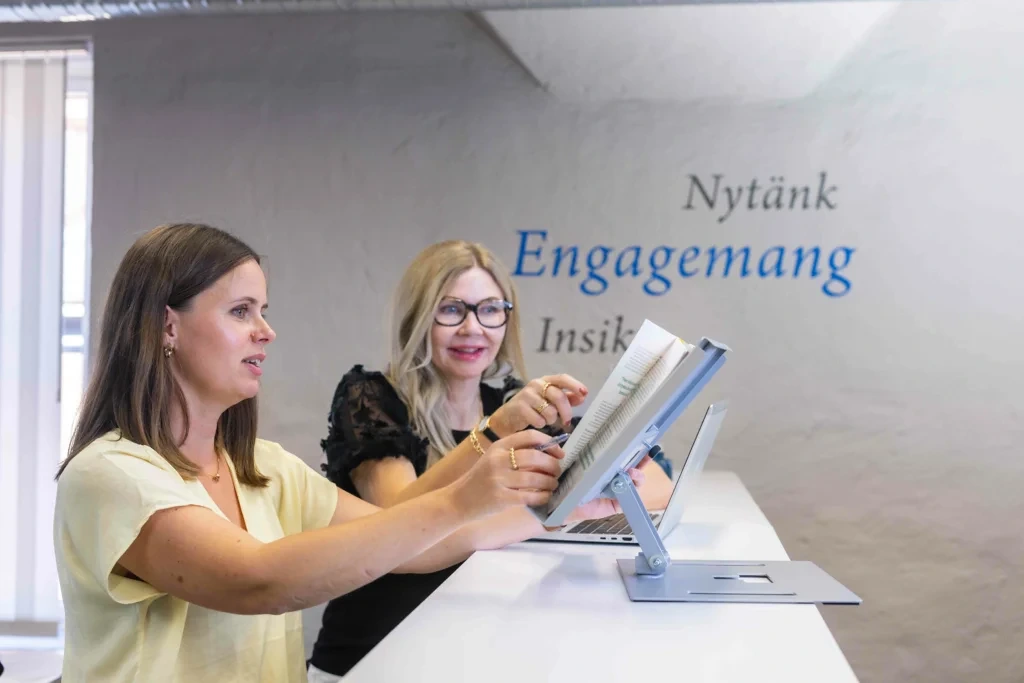
Top-quality copy is more than just translated content – cultural and local adaptations are crucial!
Because your marketing material represents your company and is the shop window for your brand, it’s essential that the translation is not only accurate and reliable, but also captures the tone of voice through the right choice of words and style.
The translation of marketing material is not just about translating from one language into another, it’s also about putting a message across in a way that feels natural, relevant and well aimed in the target language. The reader must never suspect the text was originally written in another language.
A good translation requires a delicate touch, linguistic creativity, equivalence and a profound understanding of the source text, the market and the target audience. The translator must understand the message the writer seeks to convey and know how to adapt it so that the target audience receives it as intended. It’s all about finding wording that properly reflects the meaning of the original, while also adapting the tone of voice, style and expression to make the text sound natural and at ease in its new context.
When translating technical texts such as user manuals and medical information, the main requirement is for the content to be rendered accurately and unambiguously. The same also applies to marketing texts, but these require further treatment and adaptation. The translator must be able to reformulate and restructure the material, and make sure the tone of voice reflects the company's brand and suits the target market and audience. Also, factors such as content area and search engine optimisation may be important aspects, particularly in digital channels. Språkbolaget has the necessary experience and expertise to ensure your marketing communication works equally well in all languages, regardless of the channel.
The translated text may need adaptation to cultural differences between countries to ensure messages and communications are well received. What may sound new, fun and laid back in one environment may be incomprehensible in another, or perhaps even impolite or offensive. This is particularly true in advertising and copywriting where it’s essential to have an understanding of, and a good feel for, your market and recipients from different cultural backgrounds.
Translation is one thing, localisation another
Translating a text into another language is difficult enough; it’s a task that requires an experienced professional. But in the case of marketing texts, localisation may also be necessary. Why? Because localization is about looking beyond the wording; it’s about giving the translated text the same (equivalent) function in the target language region – what translation theorists call the locale – as in the source language region. While this can apply to such obvious details as converting measurements and currencies, it can also be about finding relevant equivalents for web pages, legal texts and the official names of authorities. Here, the translator and project manager remain in touch with the client and make no crucial decisions without the client's approval. In the case of marketing, it may also involve adapting the message such that it cannot be perceived as foreign, offensive or provocative. A German or Japanese customer expects a completely different tone of voice than a Swedish one, and what might be a light-hearted joke in one language may be grossly offensive in a different culture. By localizing your marketing material you are protecting yourself from embarrassment, from sounding incompetent and from breaking marketing laws, unwritten rules and social norms.
Translation pure and simple is not enough for marketing texts, where it’s all about creating a feel that reflects the company's brand. It’s not just what is said in the text, but how it is said that provides a text with punch. So it can be a good idea to consider transcreation for marketing texts.


What is transcreation or copy translation?
Transcreation, aka copy translation, is 19freer and more creative than classic translation. The method is applied primarily to marketing texts and is an additional step taken to ensure your message gets across in the way you intend. A brand uses a tone of voice, storytelling and visual content to create a specific effect on recipients. However, there are often many subtle nuances that cannot be translated directly. One example is a company slogan that consists of a witty play on words, which when removed from its original linguistic and cultural environment, may well fall flat. This is where transcreation comes in. Copy translation focuses on the feeling you wish to convey and how it can be recreated in another language and culture. A translation is not always enough to achieve the impact you desire in the new market; a completely reworked text with a new visual expression may be necessary. A copy translation adapts your source text to the target audience in the intended market. Contact us early in the project and let us help you find the right level and the right tone, and set up a process and schedule that suit your needs.
Different campaigns in different countries – when is transcreation suitable?
Different campaigns need to be presented with different messages from country to country. This applies equally to major international companies as to smaller businesses. Conditions such as the right tone of voice in the message, the imagery, the people who appear and speak in the marketing text, the product name itself and the facts that are highlighted, all vary from market to market. Translating the source text is only part of the work. The text may have to be completely rewritten. One market might expect greater objectivity, another more personality, and a third a completely different approach, and so forth.
When is transcreation or copy translation required? A common workflow begins with transcreation, then translation. Different languages require different types and degrees of processing before the outcome suits the intended market or target group. The translator has to take cultural differences into account and be considerably freer in the translation. Perhaps the text also needs to include certain words or be SEO-optimised, or must perhaps adhere to a given layout space. It’s here transcreation comes into the picture. Our linguists are professional native-speaking translators well-versed in current trends, expectations and conventions in their target language areas.
A text that has undergone transcreation, rather than simple translation, has the same tone and evokes the same feelings in its new linguistic environment as the original text. We choose our translators to make sure your texts elicit the intended response from your recipients, whether the text concerns factual product descriptions, inspiring blog posts or compelling ads. Get in touch and let us help you find the right process and the right translator or transcreator for your project.


The key to a successfully translated marketing text!
It’s not only the content that’s important, but the entire context – the environment in which your text will be presented. Together, we review the important things to consider to help you achieve the best possible result.
Your requirements
Start by identifying your own requirements. What do you seek to achieve?
The goal and the message
Once you have identified your requirements, you also need to set a goal. What is the message? What do you seek to convey? Your message must be clear for the translation to be clear.
The recipient
What is your target audience and your market? Whom do you wish to reach? Which market do you seek to influence? This may involve different demographic, geographical, and behavioural groups. Different target groups and/or segments may need different approaches and texts.
Cultural adaptation
The translation must take cultural differences into account and the message must be presented in a way that is relevant to the target audience.
Channel
Which channels will be used? How should the message be put across? Does the translation need to be SEO-optimised? Are there print area constraints to consider? Must the alt texts also be keyword-optimised? There are many aspects to identify for the translation to be as good as possible.
Linguistic precision and style
Once the above is clarified, it’s time to review the company's linguistic requirements regarding tone and style. How does the company want to convey its message? At what linguistic level? What approach should characterise the texts? What approach do the recipients expect? Not only must the translation be precise and clear, it must also use the correct terms and expressions. The translation must reflect the brand's tone and style in the target language.
Translation method
There are several methods for tackling a text. For pure information sharing to employees within a company, carefully post-edited machine translation can go a long way. But for a marketing text designed to convey a message, evoke emotions and strike the right chords, human translation, transcreation and localisation are the primary methods. It may take longer. It may cost more. But together with us, you will reach your goal.
Translating marketing copy and our translators
We work with many different translators. Some are pure technicians who specialise in conveying factual information and technical data to the reader in the clearest possible way. In addition to being factual, others also possess a creative talent, and are copywriters and transcreators as well as being translators. Marketing texts and copy require a great deal of creative thinking, research and adaptation – not just pure translation.
It’s not always easy to tell the difference between a copywriter and a translator. A copywriter is a professional writer, who is often also a translator. A translator is first and foremost a linguist, but many of our translators have extensive experience of both writing and translating copy and marketing texts. As a translation agency, Språkbolaget finds the right professional for every assignment. In this context, it’s important to know that a translator, however creative they may be, does not have the authority to deviate from the source text beyond a certain point. Which is why it’s absolutely vital that we review your specific requirements and instructions right from the outset, and establish the framework for communication between you, the project manager and the translator. Only then can the result be truly excellent in putting your message across.


Let us help you translate your marketing copy
We believe in the power of a well-crafted message. Our experienced translators take pains to make sure every text is both informative and engaging, with a tone of voice that reflects your brand's unique identity. By carefully analysing your target audience and your brand's core values, we select the right translator for each project and create translations that not only reach out, but also hit the mark.
Språkbolaget provides you with a team of knowledgeable translators, reviewers and project managers with many years’ experience in writing market-adapted texts across a range of industries. Many of our translators and reviewers have backgrounds and training in journalism and copywriting. They only translate into their native languages and they either live in a country where the language is spoken or have regular contact with their homeland. This is especially important as languages are constantly evolving. A translator must keep up to date with language developments and local trends in order to create appealing, contemporary texts.
Having worked for many years with high-quality translations for a multitude of clients with a wide range of needs and requirements, we’ve built up reliable, efficient processes that we can adapt to suit your particular project.
Get in touch and we’ll arrange a meeting to discuss your requirements and needs. The easiest way to contact us is via our contact form.
Articles worth reading


Take care of this summer's translation needs – without the stress
Summer is approaching – a welcome time for rest, but also a challenging period for many companies. At the same time as the holidays…

Wurst case analysis – language matters
”Now it's about the sausage – literally translated ”now it's about the sausage” – that's a German idiom with...

The pitfalls of AI translation
Many companies use AI translation as a quick and cheap alternative to professional human translation. In the right context, AI translation can be...
5 tips for successful copy translations!
-
 Make sure your text material is complete and fully finalised before translation. Although the preparatory work is time-consuming, we promise the end product will be all the better and finished more quickly with well-prepared source material.
 -
Let us help you plan your translation. We can work together to find the right schedule and workflow, and resolve any issues regarding layout, file formats, linguistic conventions, proofreading etc.
-
Send us any reference material, previous translations, terminology lists and language or style guides you may have. This allows the translator to become familiar with your material and find the precise terminology and perfect tone of voice to introduce your business.
-
If there are any critical aspects you feel might be good for us to know, please don’t hesitate to mention them. For example, there might be previous translations you’re dissatisfied with or words you prefer us not to use. They may also be words, terms and phraseology that could be misunderstood and lead thoughts to your competitors. All such information helps us avoid problems, save time and get the translation right, right from the outset.
-
Give us feedback! We'll take on board all your comments and fine-tune our collaboration.

Språkbolaget translates most types of marketing texts
Here are some examples of marketing texts we work with:
-
 Google Ads campaigns
 -
Screenplays and promotional videos
-
Leave-behinds
-
Annual reports
-
Advertisement texts
-
Packaging texts
-
Market research
-
Financial texts
-
Banners
-
Information texts
-
Reports
-
Leaflets
-
Brand books and style guides
-
Posts & social media texts
-
Advertising leaflets and advertising translations
-
Newsletters
-
Brochures
-
Manuals
-
Signs
-
White papers
-
Content
-
Campaigns
-
Training material
-
Copy
-
Catalogues & folders
-
Websites & webpages
See what our customers have to say
”It was important for us to find a partner with experience from our industry in order to make sure the terminology was correct. Språkbolaget led us throughout the process and delivered quality in a very short space of time. Now we’re looking forward to reaching out to new target audiences. ”
Maria Öst, Communications Officer, Swedish Women's Voluntary Defence Service

“We’re very pleased with the collaboration and especially the excellent communication with our project manager. It was easy to get in touch and ask questions, and we were kept informed along the way, which made for a smooth process, even though it was a relatively big and time-consuming project.””
Andreas Stridh, Product and Quality Manager, Pharma Systems

“We were truly glad we chose Språkbolaget to translate our book. They always replied quickly and were responsive to our needs. They stuck to their commitments, which combined with their personal approach, made us feel safe and ‘visible’ throughout the process.”
Niklas Eriksson and Pär Skoglund Finquist, authors of “The Leader’s Gearbox”.
“We’re extremely satisfied with Språkbolaget. They translate our annual reports and a great many other business documents besides, which they always do quickly and accurately, even when time is tight. And because they’re also very pleasant and easy to work with, we always feel we’re in safe hands.”

“The online youth clinic Umo.se, Vårdguiden 1177 and a number of organisations and universities have asked for permission to publish and distribute our material, which they would never have done had it not been so well translated. We also note that we’re getting hits from abroad, and that’s a good sign,” says Magdalena Abrahamsson.

”Språkbolaget are professional, accommodating and always listen to the customer's needs. They've helped us translate various research papers. In every single meeting, they've always been responsive to our wishes, accessible and delivered on time.”

”Språkbolaget was a great help when we were looking to translate a lot of information into various languages for new families following childbirth. We’ve enjoyed great contact with Språkbolaget from the very beginning and have had nothing but good experiences.”

”The quality of our deliveries is of the utmost importance to us at Invinn. In Språkbolaget, we’ve found a partner with a professional, pleasant approach and who delivers quality on time. They’re transparent with their schedules and quick to respond to input and comments. Both Invinn and our customers feel equally confident with Språkbolaget as our supplier.”

”Plannja uses Språkbolaget for translations of product brochures and installation instructions for subsidiaries in Poland, Denmark, Norway and Finland. Plannja's customers value quality, reliable delivery and clear communication. For us at Plannja, it is therefore important that this permeates our entire business at all levels, including with suppliers. Språkbolaget is a supplier that meets our expectations extremely well. They provide us with a prompt response and we can always feel confident that we will receive information and delivery on time.”

“Many companies, and especially the biggest, naturally recruit worldwide. We’ve reached 300,000 reference checks per year, which means the texts in the app must be translated into many languages, and for that we’ve enlisted the help of Språkbolaget,”

“We’re putting a huge responsibility on Språkbolaget, and we really have very little opportunity to check all of the translations. However, we’re fully confident that the texts will be as clear as required

Request a quotation
Our quotations are free of charge and non-binding
Fill in your details, tell us what you need translated, and we'll get back to you to arrange a personal consultation.
-
Tailored prices
-
Personal project manager
-
Qualified professional translators
-
We work exclusively with businesses
-
Short delivery times
-
Strict confidentiality
Request for quotation
Or email us at: info@sprakbolaget.se
Request a quotation
Our quotations are free of charge and non-binding
Fill in your details, tell us what you need translated, and we'll get back to you to arrange a personal consultation.
-
Tailored prices
-
Personal project manager
-
Qualified professional translators
-
We work exclusively with businesses
-
Short delivery times
-
Strict confidentiality
Request for quotation
Or email us at: info@sprakbolaget.se
FAQs
Let's get started
Who is your target audience?
Språkbolaget caters to businesses, authorities and organisations that want a reliable language partner, a smooth working process and personal dialogue. We are a full-service translation agency, which means we can help you with all your translation needs – from annual reports and sales brochures to video subtitling.
How is my personal data processed?
Making sure your personal data is processed safely and securely has always been important to us.
We have updated our privacy policy to clarify how we protect your personal data in accordance with the EU's new General Data Protection Regulation (GDPR).If you wish to read our privacy policy, you can find it here.
What can I expect from you?
Quality assurance, strong project management, an international network and professionalism form the foundation of what we deliver to our clients. It’s what every client, large or small, can expect from Språkbolaget. But we actually deliver so much more – peace of mind, a personal relationship and a passion for making sure our clients are satisfied with our work and will want to use us again. The personal dimension in our collaborations builds trust, and projects are always performed best by people who trust each other.
How do I go about hiring you?
Send your text to us and we'll send you a quotation. You can contact any of our project managers directly by email or phone or submit a request for quotation..
Would you like to discuss a collaboration now or later? Contact one of our project managers directly.
Language and services
What languages do you translate into?
We translate to and from most languages. Here are some languages we frequently translate into:
Arabic, Bulgarian, Chinese (simplified and traditional), Czech, Danish, Dari, Dutch, English, Estonian, Farsi, Finnish, French, German, Greek, Indonesian, Italian, Icelandic, Japanese, Korean, Latvian, Lithuanian, Norwegian, Polish, Portuguese, Romanian, Russian, Slovak, Somali, Sorani, Spanish, Swedish, Thai, Tigrinya, Turkish, Ukrainian and Vietnamese. If you cannot find your language in the list above, feel free to ask us.
Which industries do you specialise in?
Språkbolaget translates and copyedits advertising and marketing texts across all industries. These include customer and internal magazines; financial reports; legal, technical and medical texts; IT‑related, HR‑related and management texts; and public information. We also provide Easy Swedish, Easy English and audiovisual translation services. We work exclusively with businesses.
Which services do you not offer?
We work exclusively with businesses. We refer to private individuals to the SFÖ website. We do not provide interpreter services.
Can I get my translation in the same layout?
Yes, if you send us a text in InDesign or other formats, we return the translation in the same layout. We also offer additional DTP services if you need print-ready files back. Please specify this when ordering or submitting a request for quotation.
Do you do express jobs?
Yes, absolutely. We'll do everything we can to make sure you get the material back when you need it. Contact us here. Let us know when you need your translation and we'll get back to you without delay.
Pricing and delivery
How much will your translation cost?
The price of your translation is based on a combination of criteria, such as the text’s subject matter and level of difficulty; the text volume; the target and source languages; and the deadline.
Translation prices are very much about supply and demand. Some languages have fewer available translators within specific subject categories, and the prices are thus higher than for languages and subjects where there are more translators to choose from. Some languages are more labour-intensive than others, and a text may need further adaptation to the cultures of the different target countries. Upload your file for a quotation. If the file is large, we recommend you use WeTransfer.
Do you offer contract prices and volume discounts?
Yes, of course. If you have regular translation needs with large volumes, we'll be happy to offer you a contract price. Contact one of our project managers here.
Do you charge extra for express delivery?
We charge an additional 10–100 % for express delivery. Express delivery costs more because the translator has to put other assignments on hold and may have to work overtime to complete yours. In most cases, the work will be completed quickly even without express delivery, so the surcharge may not be necessary. Upload your file with the proposed delivery date for a quotation. If its a large file, we recommend you use Wetransfer.
How quickly can I get my translation?
Delivery times depend primarily on the availability of a suitable translator and the volume of text. A good rule of thumb is to assume a translator has the capacity to translate around 2,000 words per day. On top of this come project management, language checking and file handling. When you receive a quotation from us, we also provide a delivery date. If you have a specific deadline to meet, please state this in your request for quotation and we’ll take it into account. If you’re in a particular hurry, we offer an express service where you can get your text translated extra quickly. Request a quotation here.
Translation process and quality
What does your working process involve?
Our standard work process involves a native-speaking translator with specialist expertise in the relevant field who translates and reviews their own text. After that, a different translator steps in to review the text again. As a regular client, you have the opportunity to use the same translator and the same project manager every time. We can set up specially tailored work processes and workflows for different types of projects. Contact us if you'd like to discuss your project with one of our project managers. We've spent many years honing our work process. Read some of our client case studies here.
Who translates my text?
A qualified native translator specialising in the relevant subject area translates the text, and a second qualified translator reviews it, in accordance with our standard workflow.
What qualifications do Språkbolaget's translators possess?
To be approved as a translator with us, candidates must be trained as translators, translate into their native languages, keep abreast of developments in their languages, have documented experience and good references. They must also pass Språkbolaget’s own tests. We monitor our translators closely and have developed a quality control system to help us choose the right translator for a particular text
How do you guarantee quality?
Språkbolaget offers a quality guarantee for all translations. We only use translators who meet our quality standards, and we have a documented workflow that involves an additional review of all texts. However, should you not be satisfied with our work, we will revise the translation free of charge according to all applicable notes until it meets your requirements.
How do you guarantee confidentiality?
All our employees, translators and partners have entered into non-disclosure agreements. Should you require an additional confidentiality agreement, we are more than happy to sign one.
Do you offer certified translations?
Yes, many of our translators are authorised by the Legal, Financial and Administrative Services Agency. Contact one of our project managers here to check availability.
What file formats can you accept?
We work in a wide variety of programs and formats such as Word, PowerPoint, Excel, PDF, InDesign, Photoshop, Illustrator and many more. Ask us here!
Other
How do I pay?
In the case of new clients, we carry out a credit check before beginning a translation project. Our standard terms of payment are 30 days, and we prefer to send invoices by email, but if you would rather receive your invoice by post, that's perfectly OK. Large projects are invoiced in instalments.
Where can I find your terms and conditions?
You can find our terms and conditions here.
How do I join Språkbolaget's team of translators?
To join our international team of translators, you must have a degree in translation or the equivalent for the languages you translate from, and translate into your native language. You must also have at least two years' experience of professional translation, and you must work as a freelance translator through your own business. You must also have good, documented knowledge of the subjects you translate. Send your CV to info(@)sprakbolaget.se.
We receive a great number of applications, so we do not have time to reply to all of them. However, we save all serious applications and will get in touch if the need arises.