





The Leader's Gearbox: a translation project where the human touch beats AI

“We were truly glad we chose Språkbolaget to translate our book. They always replied quickly and were responsive to our needs. They stuck to their commitments, which combined with their personal approach, made us feel safe and ‘visible’ throughout the process.”
Niklas Eriksson and Pär Skoglund Finquist, authors of “The Leader’s Gearbox”.
The Leader's Gearbox: a translation project where the human touch beats AI
The Leader’s Gearbox: your path to active, joyful leadership, published in September 2025 by Own Your Book. The authors, Niklas Eriksson and Pär Skoglund Finquist, have extensive experience as managers and leaders, both in Sweden and internationally. The book is intended as a practical guide that encourages reflection, so that its readers can turn words into deeds and apply the ideas directly to their own leadership. The book is based on a concept where the various leadership abilities a manager needs are likened to the gears in a car. The gear a manager should engage depends on the situation and whoever the manager is leading. You must be able to lead yourself (1st gear) before you can change up and lead others. An ability to engage reverse gear (R as in reflection) is also essential for sustainable leadership and learning more along the way.
“We’re passionate about making leadership happen in everyday life by implanting leadership abilities into the minds of managers and leaders,” explains Niklas. “We want to embolden them to change up, change down and change gear more often as leaders.”
The book enjoyed an enthusiastic reception and the authors use it as literature in their popular leadership courses. It seemed only natural to have it translated into English to reach a wider audience.
“There are a lot of books about leadership published in English,” says Pär, “but we believe ours will stand out from the crowd. No one else is talking about the importance of ‘leadership gear change’, which makes us unique both in terms of our concept and our book.”
The question was how the book should be translated.
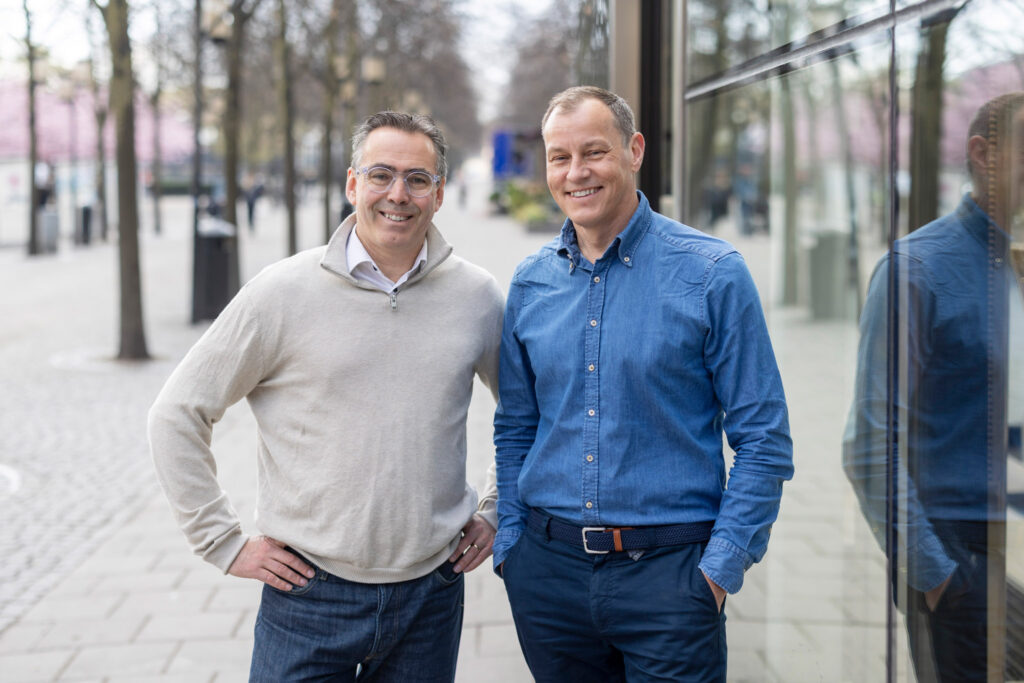
Photo: Liza Simonsson
Trust determined the translation method
Books are usually translated by human translators to ensure a result of sufficiently high quality, but in recent years, AI translation with post-editing has reached such a level that even this method was a viable alternative.
The authors obtained quotes from several language service providers and studied various solutions.
"We did a thorough analysis and compared various translation agencies, and we also considered machine translation," says Pär. "What tipped the balance was trust. We use a personal, direct tone a voice in the book that we were eager to keep in the English version. To make sure it would be preserved, we chose to go with human translation. While the price was naturally somewhat higher, the difference wasn't big enough for us to risk the quality just to save a few hundred euros."
The authors plumped for Språkbolaget, and Ida Norlander was appointed project manager. Ida remarks that the authors realised something early on that not all clients are aware of at all – that even though the price for the translation step itself can be driven down by using AI, it backfires when it's time to elevate the AI translation to human quality. Post-editing an AI translation to endow it with the same personal feel and finesse that a human translator gives it from the outset is a complicated process.

A simple, straightforward translation process
“The whole process was simple and straightforward,” explains Niklas “We began with a test translation of an extract from the book. Once we had evaluated that part of the process, we split the translation into two partial deliveries. This was a good setup as we use a number of specific terms that are important to render consistently throughout the book. It enabled us, together with the translator, to find the right tone of voice and phraseology, which all went very well.”
“It’s precisely this balance between the requirement for consistent specific terminology and the desire for linguistic variety that AI finds so very difficult to achieve,” observes project manager Ida Norlander. “Reaching that level from a raw AI translation can take almost as long as traditional translation.”
This is confirmed by the highly experienced translator chosen by Språkbolaget for the assignment:
– When I translated Niklas and Pär's book ”The Leader's Gearbox”, I saw it as my most important task to convey their ideas, concepts and intentions rather than simply translating the individual words. Doing so in a way that suits the intended readers was a further challenge.
“AI is undeniably an impressive tool,” the translator continues, “but an AI tool can never put itself in the author's – or in this case, the authors' – thoughts. Not to mention the thoughts of the intended readers. Nor can AI ask for clarifications or work together with the authors to find precisely the right wording. For this reason I’m convinced that real, human, analogue translators retain an important place in translation – particularly in literary translation.”
The challenges of reviewing translated technical text
Whether a text is translated by AI or a human, Språkbolaget always includes a review stage, which can look quite different depending on whether AI or, as is the case here, a human has taken care of the translation. Our reviewer comments:
“One of the challenges when reviewing non-fiction translations is knowing which words and expressions constitute key terms – and must thus be translated consistently – and which expressions can be varied to good effect with synonyms or paraphrases to make the text flow better. In contrast to texts translated by AI, where important terms tend to be translated differently throughout the text, the reviewer and translator are able to discuss how terms and more general expressions are best rendered.”
The reviewer continues: “Metaphors present another challenge. In The Leader’s Gearbox, the car and its parts are used as central metaphors. The translator and I discussed the extent to which the metaphors could be transferred directly into English, and where it was more appropriate to paraphrase to highlight the actual idea behind the text. These are balances that can only be struck between human translators and reviewers: metaphors that work well in the source language, but which would be stilted or even incomprehensible in a direct translation, receive a more natural interpretation.”
Creativity is its own reward
The person responsible for holding together all of a project's components and people, in principle the client, translators and reviewers, is of course the project manager – in this case Ida Norlander:
“As project manager, I had overall control, especially over the practicalities involving files and delivery times, and I also had a great deal of insight into the linguistic work. I helped brainstorm ideas concerning various expressions and also passed on and discussed comments and thoughts between Pär and Niklas and the translator and reviewer – in both directions. What struck me most was how important and rewarding it was to make room for linguistic creativity and discussion, and that together we were able to examine wording from every possible angle. I believe it’s precisely this interplay between people that is the key to a successful end result.”
Pär and Niklas agree with that analysis.
We were truly glad we chose Språkbolaget to translate our book. They always replied quickly and were responsive to our needs. They stuck to their commitments, which combined with their personal approach, made us feel safe and ‘visible’ throughout the process
Key lessons from the book project
There are many lessons to be learned from this book project, but perhaps the most important is that the choice between human and AI translation is not simply a matter of cost. What’s more, the difference in cost is not all that great when you consider the overall process, including reviewing and post-editing. But the human element is more important still. Only a human can understand an author’s thinking and intentions, and convey it to the target audience, which not only speaks a different language, but also has a different culture, background, expectations and needs. AI translates very quickly indeed, but it cannot take into account the aspects that eventually govern a book's reception, reviews and sales.